Saturday, August 27, 2016

Diamond Candy Twist (Like Candy Crush)


Its an Adventure Game. your target is to reach the red flag.
☆☆☆☆☆ Features ☆☆☆☆☆

An addictive match-3 adventure game.

Eye-catching graphics and colorful gameplay.

Spectacular boosters and bonus rewards to help with those challenging levels.

100 of well-designed Free levels! Free levels and game modes added regularly!

Take on your friends to compete for the best score.

Sync your progress with facebook and leaderboard.

Easy to play, but a challenge to fully master.
Leaderboard to check your progress.

☆☆☆☆☆ How to Play ☆☆☆☆☆

Switch and match 3 or more candies, think twice before every move! because you have limited moves

Beat tough levels with the help of boosters!

Less moves you pass a level, higher score you'll get. Can you score high enough to earn 3 stars on each level?

This game is totally free to play but some in-game items may require payment.
Hope you will Enjoy! New updated scene Coming Soon.
Cheers

Download Link:
Click Here

Wednesday, April 23, 2014

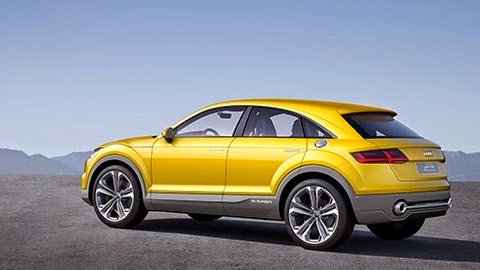
Audi TT offroad

Der Audi TT offroad concept

Mit dem Audi TT offroad concept geben wir einen Ausblick darauf, wie wir uns ein neues Modell in einer künftigen TT-Familie vorstellen können“, sagt Prof. Dr. Ulrich Hackenberg, Vorstand für Technische Entwicklung. „Er vereint die sportlichen Gene des TT mit den Stärken eines kompakten Audi SUV. Sein Plug-in-Hybrid-Antrieb mit der Möglichkeit des induktiven Ladens ist ein großer Schritt in die Mobilität der Zukunft. Wir präsentieren den Audi TT offroad concept bewusst auf unserem zweiten Heimatmarkt China, weil er für die urbane Mobilität von morgen steht – er ist nachhaltig, dynamisch, intelligent und vernetzt.“

Der Plug-in-Hybrid-Antrieb

Der Plug-in-Hybrid-Antrieb des Audi TT offroad concept liefert 300 kW (408 PS) Systemleistung und 650 Nm Systemdrehmoment. Das Showcar beschleunigt in 5,2 Sekunden von 0 auf 100 km/h und erreicht die elektronisch begrenzte Höchstgeschwindigkeit von 250 km/h mühelos. Sein Verbrauch beträgt lediglich 1,9 Liter Kraftstoff pro 100 Kilometer – ein CO2-Äquivalent von 45 Gramm pro Kilometer. Der Audi TT offroad concept kann über 50 Kilometer weit rein elektrisch und damit lokal emissionsfrei fahren, seine Gesamtreichweite liegt bei bis zu 880 Kilometern. Als Verbrennungsmotor dient ein 2.0 TFSI, der 215 kW (292 PS) Leistung und 380 Nm Drehmoment abgibt. Der Zweiliter-Vierzylinder mit dem großen Turbolader hat die schlagkräftigen Effizienztechnologien von Audi an Bord. Im Teillastbereich senkt eine zusätzliche indirekte Einspritzung, die die Benzindirekt-einspritzung ergänzt, den Verbrauch. Der Abgaskrümmer ist im Zylinderkopf integriert – die Basis für das hochleistungsfähige Thermomanagement.


Der quer montierte 2.0 TFSI arbeitet über eine Trennkupplung mit einem Elektromotor zusammen, der bis zu 40 kW Leistung und 220 Nm Drehmoment produziert. Die schmale, scheibenförmige E-Maschine ist in die Sechsgang e-S tronic integriert; das Doppelkupplungsgetriebe schickt die Antriebsmomente auf die Vorderräder. Unabhängig von dieser Antriebseinheit sitzt an der Hinterachse des Audi TT offroad concept eine zweite E-Maschine, die maximal 85 kW und 270 Nm aufbringt.

Vor der Hinterachse liegt eine flüssigkeitsgekühlte Lithium-Ionen-Batterie, die sich aus acht Modulen zusammensetzt. Sie trägt zur ausgeglichenen Gewichtsverteilung von 54 : 46 Prozent (zwischen Vorder- und Hinterachse) und zum niedrigen Schwerpunkt bei. Die Batterie speichert bis zu zwölf kWh Energie, genug für 50 Kilometer elektrische Reichweite. Zum stationären Laden dient eine Audi-Wallbox, die die Energiezufuhr komfortabel und intelligent regelt und mit unterschiedlichen Spannungen und Steckdosen zurechtkommt.


Alternativ dazu ist das Showcar auf die Technologie Audi Wireless Charging ausgelegt, das kontaktlose Laden per Induktion. Die Infrastrukturseite – eine Platte mit einer Spule und einem Umrichter (AC/AC-Wandler) – wird auf den Parkplatz des Audi TT offroad concept gelegt und ans Stromnetz angeschlossen. Wenn das Auto auf die Platte fährt, startet der Ladevorgang automatisch: Das magnetische Wechselfeld der Infrastrukturseite induziert mit 3,3 kW Leistung über den Luftspalt hinweg eine Wechselspannung in der Sekundärspule, die im Boden des Automobils montiert ist. Der Strom wird gleichgerichtet und ins Bordnetz eingespeist.


Sobald die Batterie vollgeladen ist, endet der Ladevorgang selbsttätig. Er dauert etwa so lang wie das Laden per Kabel, der Fahrer kann ihn jederzeit abbrechen. Der Wirkungsgrad der Audi Wireless Charging-Technologie beträgt mehr als 90 Prozent; Witterungseinflüsse wie Regen, Eis oder Schnee beeinträchtigen ihn nicht. Das Wechselfeld stellt keine Gefahr für Menschen oder Tiere dar – es baut sich nur dann auf, wenn ein Auto über der Platte steht.


Der Innenraum

Der Innenraum des Audi TT offroad concept bietet vier Personen Platz, zwei Erwachsene können bequem im Fond sitzen. Die schlanken Sportsitze mit integrierten Kopfstützen garantieren den Seitenhalt, bei den vorderen Sitzen sind die Wangen noch stärker konturiert.


Auch im sportlich gezeichneten Interieur des Showcars dienen die Design-Ideen des neuen TT* als Leitlinie. Die Oberseite der Instrumententafel ist als Flügel gestaltet. Getragen wird dieser durch eine sichtbare Struktur aus Aluminium, die als horizontales Gestaltungselement die Luftausströmer aufnimmt und die Breitenwirkung des Interieurs unterstreicht. Die runden Luftdüsen erinnern an Jet-Triebwerke und bergen die Bedienung der Klimatisierung. Die schlanke Instrumententafel ist auf den Fahrer fokussiert.

Sunday, April 6, 2014

Digital Tutors – Introduction to Mecanim in Unity

Digital Tutors – Introduction to Mecanim in Unity
English | MP4 | H264 1379 kbps 15 fps |1280×720 | AAC 32 kbps 44 KHz | 817 MB
Genre: elearning


 In this Unity tutorial, we are going to learn how to get up and running using the Mecanim system in Unity. We’ll start out by discussing some basic guidelines for exporting characters from a 3D package of your choice. Then we’ll discuss the import settings in Unity and get right to work on bringing our character to life. We’ll learn how to utilize the humanoid rig in Unity and how to split up our animations from our FBX character file. Then we’ll learn how to setup state machines and blend trees that will allow us to blend multiple animations together based on our key presses while playing the game. Then we’ll discuss how to utilize layers and avatar masks to override certain animations on top of other animations. Finally we’ll end the tutorial by learning how to re-target a character’s animations to a whole new character.


 Download Links: (No Password & Free High Speed Downloading)

 Unity_Part_1

 Unity_Part_2

 Unity_Part_3

 Unity_Part_4

 Unity_Part_5

Unity_Part_6 

 Unity_Part_7

Unity_Part_8 


Sunday, February 23, 2014

Flappy Bird


Meet the new Flippy Bird!
Flap your wings to fly...
[How to play]
> Tap to flap your wings to fly.
> Avoid pipes.
> Try to get 4 medals: Bronze, Silver, Gold (hard), Platinum (very hard)


DOWNLOAD LINK : CLICK HERE

Tuesday, February 5, 2013

Thursday, December 13, 2012

2014 Ford Fiesta 1.0 EcoBoost First Drive

Many Americans won't like engine downsizing, but if automakers hope to meet increasingly strict Corporate Average Fuel Economy (CAFE) standards, we'll have to get used to it. In Europe, small engines have been a way of life for years, with sub-1.5-liter powerplants common. But that's there. Will Ford's latest small-displacement offering for the U.S. -- the turbocharged 1.0-liter three-cylinder EcoBoost engine coming for the 2014 Ford Fiesta -- make a positive impression here?

First introduced in the Euro-market Ford Focus earlier this year, the 1.0 EcoBoost makes the logical move to the smaller Fiesta, coinciding with the B-segment car's mid-cycle refresh. In the 2014 Fiesta, the turbo three-cylinder setup yields 123 hp and 148 lb-ft of torque - up just 3 hp from the lower trim, naturally aspirated 1.6-liter I-4 model, but with an impressive 36 more lb-ft Ford invited a group of journalists to drive the new Aston Martin-nosed Fiesta in European trim before its launch later in 2013. These cars came equipped with many of the same features that will be available in the States, including Sync, which makes its European debut in the 2014 Fiesta. One feature not planned for the U.S. market -- at least not yet -- is the stop-start function, which went completely unnoticed during the first half of my drive. If you don't like the idea of your engine starting and stopping automatically, Ford allows you to turn the feature off with a center console-mounted button.


The first thing I noticed when I started the car was how quiet the engine is. Going into this event, I was curious how an inherently unbalanced three-cylinder engine would feel. Would I notice that missing cylinder? Would the violent shaking make it difficult to hold a conversation at a light? To my surprise, the answer to both questions was no. I experienced very little vibration throughout my drive, thanks to key components in reducing NVH like the vibration-absorbing engine mounts and counter-balanced front pulley and engine flywheel. The latter two parts would normally be weighted to compensate for each other, but in the Fiesta EcoBoost's case, the pieces are intentionally unbalanced to offset the natural wobbliness of the three-cylinder design. Helping keep the noise down is a timing belt that's half-submerged in engine oil. The lubrication allows the toothed belt to interface the gears smoothly. It all results in an engine you can barely hear or feel running at idle.

Though the engine is muted at low rpms, step on the right pedal and the turbocharged exhaust note resonates through the cabin. When cruising at highway speed, the tiny three-cylinder hums silently in the background. Stepping on the gas pedal also results in reasonably quick throttle response, thanks to the fast-spooling, small turbocharger. The turbo spins up to 248,000 rpm and produces a peak 20 psi of boost, which is force-fed into the 1.0-liter via a lag-reducing cylinder head-integrated exhaust manifold. On the road, the increase in low-end torque is noticeable. The drive through Malibu's winding switchbacks has a number of hills. I anticipated the need to downshift from third to second gear, but found I could leave the five-speed manual transmission in third and just power through when climbing a considerable grade. On the less-curvy two-lane portions of the drive, the engine had adequate power for passing, and turbo lag was barely perceptible.
The canyon roads also helped me get to know the Fiesta's fun-to-drive side. We've noted in previous drives of the 1.6-liter Fiesta how sharp a handler it is, and Ford's global B-car platform continues to impress in the three-cylinder version. Turn-in is precise, making it easy to navigate the car through Malibu's many consecutive tight turns. Steering feel is decent for an electric power setup, and it is transmitted through a thick, ergonomically correct steering wheel.
To further put the new Fiesta's handling chops to the test, Ford set up an autocross course at the Camarillo airport, the final stop on our drive. There, journalists were given opportunities to drive the Sonic LTZ Turbo, Honda Fit, and Toyota Yaris back-to-back against the Fiesta EcoBoost on a short course. The Sonic and Fiesta were my two favorites. Both got off the line with relative haste, and were fun to pilot through the quick esses. Given the Sonic's 400-cc, 15-hp advantage, the fact that the three-cylinder Fiesta EcoBoost felt just as good to me in this unofficial head-to-head was impressive. We'll have to wait until the U.S.-spec model is released for a real comparison. Because the engine balancing works so well, and the turbo's spool-up is so quick, the three-cylinder feels very much like a traditional I-4. If you get the average consumer behind the wheel and don't tell them what they're driving, chances are they won't know they're a cylinder short under the hood - and if the fuel economy meets Ford's projections, they won't miss that fourth piston. Though official EPA numbers haven't been announced, Ford promises more than 40 mpg on the highway and anticipates the Fiesta EcoBoost will become the most fuel-efficient non-hybrid in America. Another important factor that's yet to be announced is price. The Fiesta EcoBoost will slot above the base 1.6-liter model, but its price premium is unknown. That said, Ford says upgrading to an EcoBoost engine costs around $1000 in most of the automaker's vehicles.

Depending on the price and mpg difference, the Fiesta EcoBoost could be the one to get in the non-ST Fiesta lineup. And if the 1.0 EcoBoost catches on with the American public, we may soon see a lot more three-cylinder options in the U.S.


Wednesday, December 12, 2012

So kommt der neue Octavia

Skoda zeigt in Genf 2013 die dritte Generation des Octavia. Die kompakte Limousine ist größer geworden und bietet innen mehr Platz. Erste Bilder!


Erlkönige haben wir schon ein paar gesehen. Jetzt ist Schluss damit! Hier sind die ersten offiziellen Bilder des Skoda Octavia Nr. 3. Nach Eurem Geschmack?

Auf dem Autosalon Genf 2013 (7. bis 17. März) feiert die dritte Generation des Skoda Octavia Premiere. Laut Skoda-Technikvorstand Frank Welsch wird der nue Octavia ein "Fahrzeug mit Mittelklasse-Qualitäten zum Kompaktwagenpreis". Im Vergleich mit seinem Vorgänger sei der Octavia III bis zu 102 kg leichter und gleichzeitig größer geworden – neun Zentimeter länger und 4,5 Zentimeter breiter. Der Radstand hat um 10,8 Zentimeter zugelegt. Das Wachstum bringt mehr Platz im komplett neu gestalteten Innenraum, der Kofferraum fasst künftig 590 Liter Gepäck.